Focused Small-Business Website
A concise marketing site with a limited number of pages, established branding, ready content and few custom integrations can often move through planning, design, build and launch within this range.

Website design timeline
A straightforward business website often takes about 4–8 weeks from kickoff to launch. Larger custom, ecommerce or content-heavy projects commonly take 8–16 weeks or more.
The actual web design project duration depends on scope, content readiness, integrations, feedback speed and how much custom design or development is required. A useful timeline starts with the work that must be completed—not an arbitrary launch date.
For many small and mid-sized business websites, 4–8 weeks is a practical planning range. A simpler site with prepared content can move faster, while a custom website with many page types, ecommerce, integrations, migration work or multiple stakeholders can take 8–16 weeks or longer. The most reliable estimate comes after the sitemap, content requirements and functionality are defined.
Typical web design project duration
These ranges are planning guides rather than guaranteed delivery dates. The same page count can take very different amounts of time depending on content, approvals and technical requirements.
A concise marketing site with a limited number of pages, established branding, ready content and few custom integrations can often move through planning, design, build and launch within this range.
A site with multiple services, custom page layouts, stronger conversion planning, content refinement and SEO-focused internal architecture usually needs more discovery and review time.
Product catalogues, payment flows, advanced integrations, memberships, migrations, custom functionality or large content inventories add design, development and testing work.
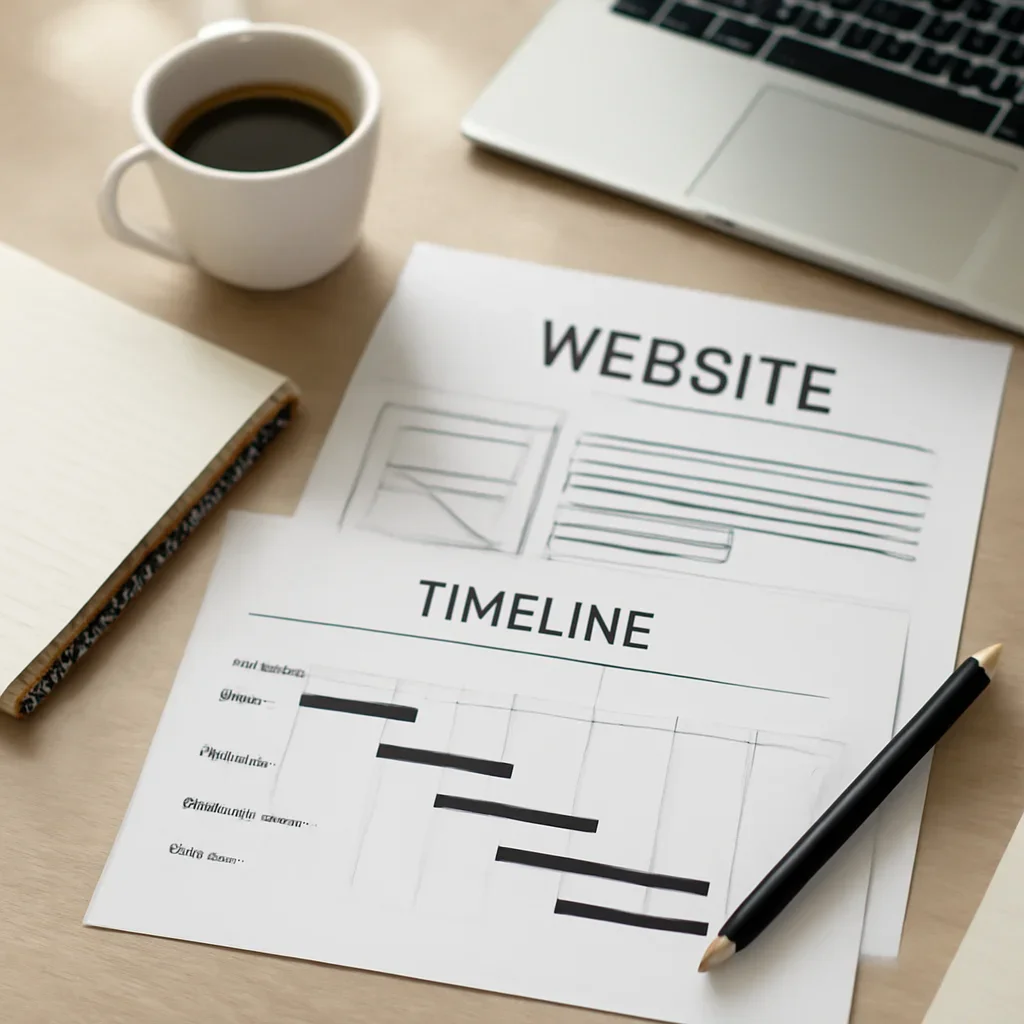
Website design timeline
The exact overlap between stages varies, but a clear sequence keeps approvals, content and technical work organized.
Define business goals, audience, sitemap, page requirements, content needs and functionality before visual design begins.
Develop or refine page content, establish visual direction and design the core page patterns that will guide the rest of the site.
Build approved layouts, configure reusable components and refine navigation, forms, images and interactions across screen sizes.
Check content, links, forms, responsiveness, redirects, analytics, technical requirements and launch tasks before publishing.
What affects the schedule
A website can be designed quickly and still launch late if content, integrations or approvals are unresolved. Identify these dependencies before setting the target date.
One project lead, approved branding, an agreed sitemap, prepared content, clear priorities and feedback returned in one organized round.
Unclear scope, missing content, late stakeholder changes, unresolved integrations and adding new page types or features after production begins.
Removing unnecessary work is useful. Compressing discovery, content or QA simply to hit a date can create rework or launch a website before it is ready.
How long to build a website
Use the table as a scoping guide. A formal project schedule should be based on the actual sitemap, deliverables and dependencies.
| Project condition | Likely effect on duration | Planning response |
|---|---|---|
| Content is ready | Can reduce delays during design and build | Approve page content before or alongside layout production |
| Many unique page types | Adds design, build and QA time | Identify reusable layouts before treating every page as custom |
| Existing site migration | Adds inventory, redirect and validation work | Audit current URLs and content before redesign production |
| Third-party integrations | May add configuration and testing time | Confirm technical requirements and access early |
| Multiple decision-makers | Can extend approval cycles | Use one project owner to consolidate feedback |
| Fixed campaign or opening date | Reduces scheduling flexibility | Prioritize must-have launch scope and move lower-priority work to a later phase |
Website development timeline Vancouver
A Vancouver service company, professional firm, retailer or ecommerce brand does not need a different production process simply because it is local. What changes the schedule is the business model, page structure, content, integrations and approval process.
Local requirements can still add work when a project includes multiple Metro Vancouver service-area pages, location-specific content, local business information, migration from an older site or coordination around a seasonal campaign or opening date.
If this page is the primary answer for web design duration, supporting Vancouver pages should link here rather than repeat the same timeline content. That keeps search intent clearer and reduces cannibalization.
Timeline by project situation
A redesign is not automatically faster because a website already exists. Existing URLs, search visibility, analytics, forms, integrations and content may all need to be audited and migrated carefully.
For redesign-specific planning, see our website redesign service. For a new custom build, review custom web design.
Usually simpler when the business has clear positioning, approved branding and prepared content but no legacy URLs or systems to migrate.
May require content inventory, redirect planning, URL preservation, analytics comparison and migration work before the new design can safely replace the old site.
Often needs additional time for catalogue setup, product data, payments, shipping, tax settings, transactional emails, integrations and checkout testing.
Prepare before kickoff
You do not need every sentence finalized, but the project moves more predictably when the core decisions and source material are available early.
A realistic schedule should identify who supplies content, who approves designs, which integrations must be tested and what must be preserved from the current website. That creates a timeline the project team can actually manage.
Plan the next step
This page should remain the main answer for website project duration. Supporting pages below address related—but narrower—planning questions.
Website timeline FAQ
These answers stay focused on project duration so related pages can target narrower launch, pricing and service questions.
A straightforward business website often takes about 4–8 weeks. Larger custom, ecommerce or migration-heavy projects commonly take 8–16 weeks or more. Scope, content readiness, approvals and technical requirements determine the actual schedule.
It can be possible for a very small project with prepared content, limited functionality and fast approvals. Compressing a larger custom project into two weeks usually means reducing scope or accepting less time for strategy, content, refinement and QA.
A focused small-business website with ready content and a limited number of page types may take roughly 3–6 weeks. More services, locations, integrations or content work can extend the schedule.
A redesign often takes about 6–12 weeks, but the range varies significantly. Auditing existing URLs, preserving SEO value, migrating content, rebuilding integrations and coordinating stakeholder approvals can add time.
Common causes include changing scope, missing content, slow approvals, multiple decision-makers, complex integrations, migration work and major design changes after production has started.
Define the required pages, unique layouts, content responsibilities, integrations, current-site migration needs, approval process and target launch date. A project team can then estimate the work rather than guessing from page count alone.
Need a realistic schedule?
Share your current website, required pages, content status, functionality and target launch date. The timeline can then be built around the work that really needs to happen.